Partnership
The project was coordinated by CORILA and implemented by a consortium of national authorities, research institutions and regional organisations from Croatia, Greece, Italy and Slovenia.
Key partners:
- Ministry of Infrastructure and Transport (Italy)
- Ministry of Environment, Protection of the Territories and the Sea (Italy)
- Croatian Institute for Spatial Development
- Regional Centre of Development of Koper
- Hellenic Ministry of Environment and Energy
- National Technical University of Athens
- University of Thessaly
- National and Kapodistrian University of Athens
- UNEP/MAP Coordinating Unit, with INFO/RAC and PAP/RAC
Key objectives
SUPREME aimed to strengthen both the technical and governance dimensions of MSP, with a particular focus on transboundary cooperation and coherence across marine basins.
In particular, it sought to:
- improve understanding of maritime uses, pressures and their cumulative impacts, including future trends
- identify spatial demands of key sectors and promote solutions to reduce conflicts and enhance synergies, including multi-use
- address data gaps and improve data sharing and coherence across borders, building on existing platforms
- support the integration of marine conservation considerations into MSP, including in transboundary contexts
- promote mechanisms for cross-border cooperation and stakeholder involvement in MSP processes
- strengthen coherence between MSP and ICZM, in line with the Barcelona Convention framework
- test MSP approaches through targeted case studies in selected national and transboundary areas
Main results
SUPREME generated a shared knowledge base and practical experiences that supported coordinated MSP implementation across the Eastern Mediterranean EU countries.
The main results include:
- improved data availability and harmonisation across marine regions, supporting more consistent MSP analyses
- identification of spatial conflicts and synergies among sectors, including options for multi-use of marine space
- strengthened approaches to transboundary cooperation, including stakeholder engagement mechanisms
- integration of environmental considerations, including cumulative impacts and conservation needs, into planning processes
- implementation of pilot case studies addressing concrete MSP challenges at local and transboundary levels
- enhanced alignment between MSP and ICZM processes within the Barcelona Convention framework
Role of PAP/RAC
Within the SUPREME project, PAP/RAC contributed to strengthening the link between MSP and ICZM, ensuring alignment with the Barcelona Convention framework and its principles.
In particular, PAP/RAC led the development of key methodological and policy-oriented outputs, including:
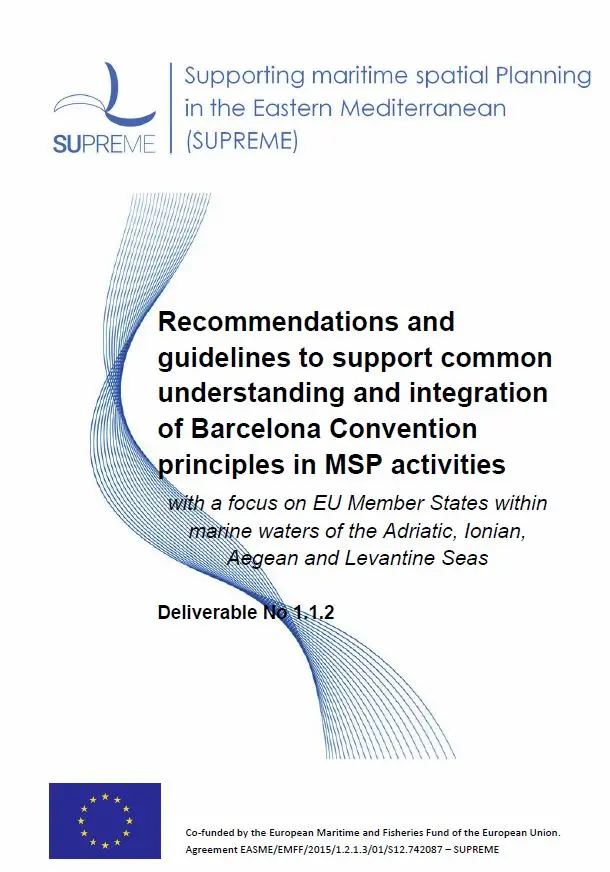
- recommendations and guidelines to support the application of Barcelona Convention principles in MSP activities, promoting coherence with ICZM and the ecosystem approach
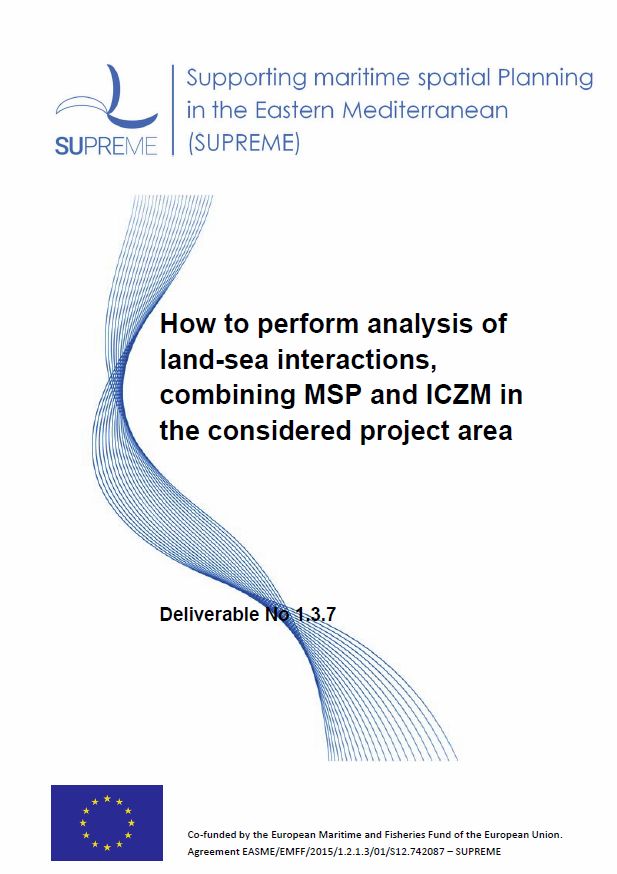
- methodological guidance on analysing land–sea interactions (LSI), combining MSP and ICZM approaches in selected project areas
Through these outputs, PAP/RAC established a technical basis for systematically addressing land–sea interactions within MSP processes, while supporting the integration of MSP into the Barcelona Convention system.