


Established in 1977 as part of the United Nations Environment Programme’s Mediterranean Action Plan (UNEP/MAP), the Centre was created to help Mediterranean countries respond to jointly identified coastal management priorities through integrated planning.
In fulfilling this role, PAP/RAC works through a network of National Focal Points – formally appointed by the Environment Ministers of the Contracting Parties to the Barcelona Convention – ensuring close coordination and alignment with country-specific priorities and regional commitments.
Add Your Heading Text Here
The Barcelona Convention is the legal framework uniting 21 Mediterranean countries and the EU to protect the region’s marine and coastal environment. Through its 7 Protocols, the Convention promotes the sustainable use of resources and provides the foundation for coordinated action towards a healthy and resilient Mediterranean in the long term.
The UNEP/MAP system is grounded in the Barcelona Convention and operates through a coordinated system of 9 units based across different offices and countries in the Mediterranean. These include the Coordinating Unit, seven specialised Regional Activity Centres (RACs), and the Mediterranean Pollution Assessment and Control Programme (MED POL).

Add Your Heading Text Here
Since it entered into force in 2011, the ICZM Protocol to the Barcelona Convention has provided the legal framework for integrated coastal zone management in the Mediterranean (ICZM).
ICZM is a dynamic process for the sustainable management and use of coastal zones, that takes into account the fragility of coastal ecosystems and landscapes, the diversity and interactions of terrestrial and maritime activities, and their impacts on marine and land areas.
Contracting Parties to the Barcelona Convention have mandated PAP/RAC to support the implementation of the Protocol on Integrated Coastal Zone Management (ICZM) and Conceptual Framework for Implementing MSP in the Mediterranean.
The Centre also helps advance the Mediterranean Strategy for Sustainable Development (MSSD), the EcAp/Integrated Monitoring and Assessment Programme (IMAP) policy and the Regional Climate Change Adaptation Framework (RCCAF).
Over the years, Mediterranean coastal zones have undergone profound change. Countries face interconnected pressures, including climate change impacts, sea-level rise, urbanisation, ecosystem degradation and increasing competition for coastal space.
Throughout these changes, our focus remains the same: creating a healthier Mediterranean by building coastal resilience and promoting sustainable development.
Throughout these changes, our focus remains the same: creating a healthier Mediterranean by building coastal resilience and promoting sustainable development.

Establishment of PAP/RAC
Launch of 10 priority actions
Launch of first CAMP
First Guidelines on ICZM
COP12 Decision to prepare the ICZM Protocol
Launch of the MedOpen online training course
Launch of the Coast Day awareness-raising campaign
ICZM Protocol signed
ICZM Protocol entered into force
Launch of the first Coastal Plan addressing climate variability and change
Adoption of the first National ICZM Strategy based on ICZM Protocol
Adoption of the first coastal plan based on the ICZM Protocol
COP20 Decision on Conceptual Framework for MSP
COP21 Decision on Common Regional Framework for Integrated Coastal Zone Management
Launch of the first transboundary CAMP
COP 23 Decision on the Conceptual Framework for the Implementation of MSP in the Mediterranean
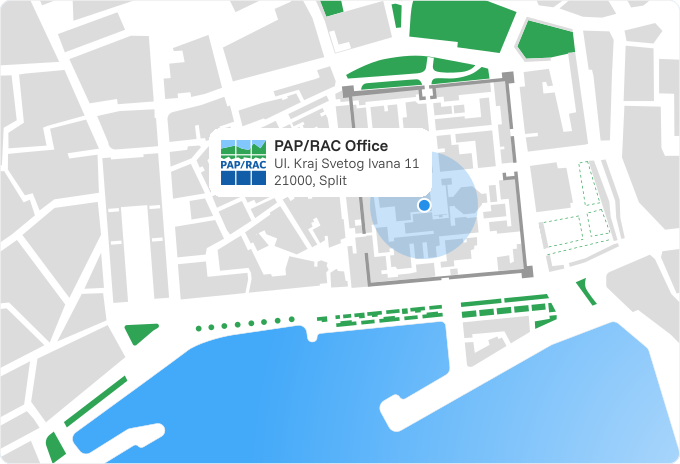
PAP/RAC is headquartered in Split, Croatia, housed within the historic Peristyle of Diocletian’s Palace, a UNESCO World Heritage Site.
The Centre operates with the support of the Government of Croatia, and from this uniquely Mediterranean location, works with partners and experts across the region to safeguard the natural, cultural and economic assets that depend on healthy coastal systems.
The Centre’s work is overseen by an Administrative Board of five members. The Chair and members of the Board are appointed by the Government of the Republic of Croatia for a four-year term.
Members of the Administrative Board for the period 2023-2027:
M.Sc. in Marine Biology and Ecology
Representative of the City of Split
PhD
Representative of the University of Split
Master of Laws
Representative of the ministry responsible for foreign affairs
PhD
Representative of the ministry responsible for environmental protection
Master of Economics
Representative of PAP/RAC