Project Overview
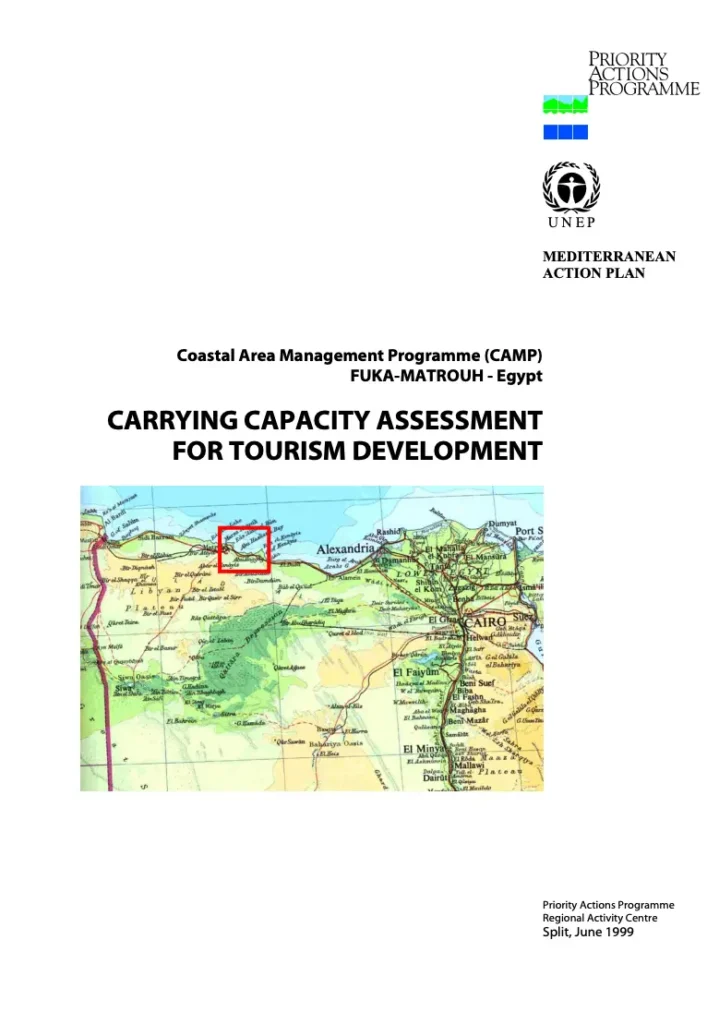
The Coastal Area Management Programme (CAMP) Fuka–Matrouh was implemented under the Barcelona Convention in cooperation with the Government of Egypt to support integrated coastal area management (ICAM) in a largely undeveloped and environmentally sensitive coastal region.
The project covered approximately 100 km of coastline from Marsa Matrouh to Fuka, including a 10–20 km inland strip characterised by low population density, semi-arid conditions and limited natural resources. The area is predominantly inhabited by Bedouin communities relying on pastoralism, small-scale agriculture and trade, with increasing pressures from tourism development and resource use.
The project aimed to introduce integrated planning approaches to balance development needs with environmental protection, while supporting more sustainable use of coastal and natural resources.
Key Objectives
Building on this context, CAMP Fuka–Matrouh focused on establishing a foundation for integrated coastal planning and management, addressing both environmental constraints and socio-economic development needs.
The project was guided by the following key objectives:
- promote integrated planning and management of coastal and inland resources
- support sustainable development of tourism in balance with local community needs
- improve management of natural resources, including water, soil and rangelands
- strengthen the protection of environmentally sensitive areas and cultural heritage
- introduce planning tools and approaches, including participatory processes, into decision-making
Main results
CAMP Fuka–Matrouh generated a comprehensive planning and analytical basis for guiding sustainable development in the project area.
The main results include:
- Support for integrated coastal planning, including:
- preparation of the ICAM Planning Study as the main strategic output for the area
- development scenarios for a regional development pole, integrating environmental and socio-economic considerations
- introduction of Strategic Environmental Assessment (SEA), Carrying Capacity Assessment (CCA) for tourism, and prospective analysis
- Strengthened knowledge base and resource management approaches, including:
- sectoral studies addressing climate change, natural resources, soil erosion, desertification and water management
- development of GIS-based analyses and use of remote sensing to support planning
- proposals for sustainable agriculture, rangeland management and soil conservation
- Integrated development and governance outcomes, including:
- measures to support the diversification of tourism and increase local employment opportunities
- proposals for revitalisation of rural and Bedouin communities
- recommendations for the protection of natural and cultural heritage
The project also provided a basis for follow-up actions, including the integration of results into national coastal management processes and the establishment of institutional mechanisms for ICAM implementation.
Partnership
- Government of Egypt
- University of Alexandria
- With the support of relevant national institutions
UNEP/MAP – Barcelona Convention system:
- PAP/RAC
- SPA/RAC
- ERS/RAC
- PB/RAC