Key objectives
- Development of an integrated and modular Ecological-Socio-Economic (ESE) management framework for the protection and restoration of marine ecosystems, examining the compatibility of maritime and coastal uses with protection measures
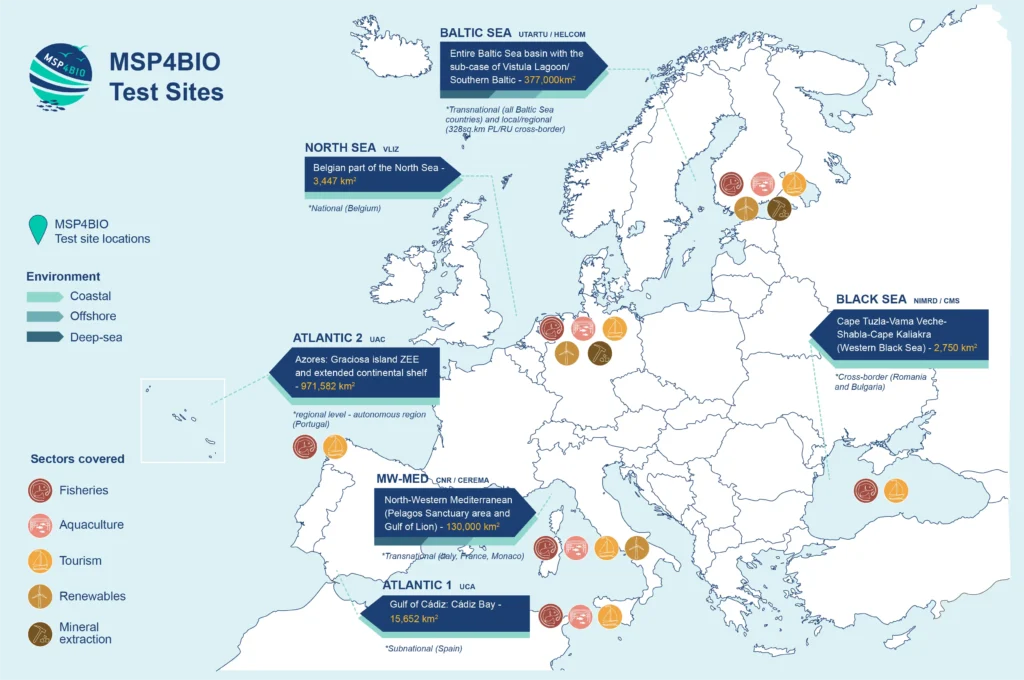
- Showcase and operationalise the ESE management framework in six test sites:
- Baltic Sea (with the sub-case of the Vistula Lagoon)
- North Sea (Belgian part)
- Atlantic 1 (Gulf of Cádiz)
- Atlantic 2 (Azores – Graciosa island ZEE and the extended continental shelf)
- North-Western Mediterranean (Pelagos sanctuary area and the Gulf of Lion)
- Black Sea (Cape Tuzla – Vama Veche-Shabla – Cape Kaliakra)
Main results
- A fully developed ESE Management Framework, offering a comprehensive approach to balancing ecological, social, and economic factors in MSP decisions, including:
- Ecological Toolkit
- Criteria for Representing Social and Economic Dimensions of MPAs
- Trade-Offs Method for Protection in MSP & Nature-Inclusive Operation of Blue Economy
- Test-site applications that demonstrated how the ESE framework can be tailored to local contexts, delivering practical, site-specific solutions
- Broad insights gained through intensive engagement with Communities of Practice across pilot sites, highlighting the importance of stakeholder involvement for sustainable outcomes
- Actionable policy solutions and recommendations addressing policy barriers in MSP processes
Partnership
Lead Partner:
S.Pro – Sustainable Projects Gmbh (Germany)
Project partners:
- Centre for Studies and Expertise on Risks, the Environment, Mobility and Urban Planning – Cerema (France)
- Centre for Coastal and Marine Studies – CCMS (Bulgaria)
- PAP/RAC (Croatia)
- Gdynia Maritime University (Poland)
- University of Cádiz – UCA (Spain)
- Nantes Université (France)
- National Institute for Maritime Research and Development “Grigore Antipa“ – NIMRD (Romania)
- University of Tartu (Estonia)
- WWF Mediterranean (Italy)
- Coastal Research and Planning Institute – CORPI (Lithuania)
- Baltic Marine Environment Protection Commission – HELCOM (Finland)
- Institute of Marine Sciences of the National Research Council – CNR-ISMAR (Italy)
- Flanders Marine Institute – VLIZ (Belgium)
- Finnish Environment Institute – Syke
- University of the Azores’ – UAC (Portugal)
- Seascape Consultants (UK)
Role of PAP/RAC
As a Regional Activity Centre under the UNEP/MAP – Barcelona Convention system, PAP/RAC had an active role in WP6 – Policy coherence and co-production of solutions.
The Centre contributed particularly to:
- analysing EU, regional sea, and national approaches to the implementation of marine biodiversity policies
- developing solutions to strengthen biodiversity protection and restoration within MSP and sectoral policies
- upscaling project results to regional and Mediterranean processes to support wider policy uptake and integration.